Are you interested in learning the German alphabet or wondering how to begin learning the German language? If you are well-versed in English, you will be able to pick up the language pretty well. The script of the English and German languages is the same. Both languages use the Roman script or the Latin script. You don’t need to begin learning the script to start learning German if you know English or any other language which uses the same script.
The best part about the language is that German words sound exactly the way they are spelt with only a few exceptions. Today, we will take a look at the letters in the German alphabet along with their pronunciations.
Let us begin with listening to the German Alphabet
German capital letters
Similar to English, German capital letters are written as below.
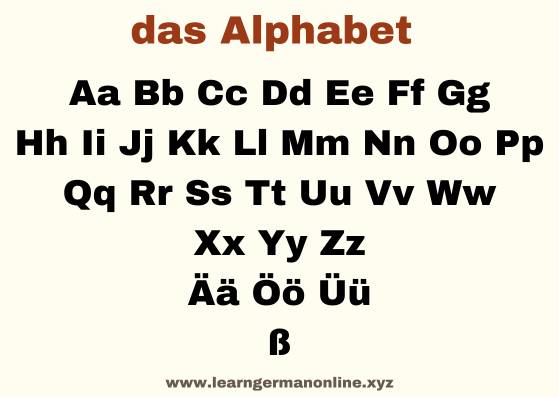
A B C D E F G H I J K L M N O P Q R S T U V W X Y Z
German small letters
Similar to English, German small letters are written as below.
a b c d e f g h i j k l m n o p q r s t u v w x y z
Which are the extra letters in German?
Ä, Ö, Ü or ä, ö, ü and ß (sharp S)
There are three German Umlauts in addition to the 26 German alphabets. An umlaut is a diacritical mark or two dots placed over three vowels in German to indicate a change in the sound. The Umlauts are placed above the letters a, o and u in German. The German Umlauts are written as Ä, Ö and Ü in capital or ä, ö and ü in small.
The ß ligature is called the as das Eszett or scharfes S (sharp S) where das is the article of the letter. Although it looks like it is similar to B, it is an over-pronounced s.
Vowels in German
Similar to English, German consists of five vowels as below.
a, e, i, o, u in small letters or A, E, I, O, U in capital letters
There are three umlauted vowels ä, ö, and ü as well.
German Alphabet and Pronunciation
A B C D E F G H I J K L M N O P Q R S T U V W X Y Z Ä Ö Ü ẞ
A B C D E F G H I J K L M N O P Q R S T U V W X Y Z Ä Ö Ü ẞGerman Letters Spelt Phonetically
| German Letter | Phonetics | German Letter | Phonetics |
| A | ah | N | en |
| B | bay | O | oh |
| C | tsay | P | pay |
| D | day | Q | koo |
| E | ay | R | air |
| F | eff | S | es |
| G | gay | T | tay |
| H | haa | U | ooh |
| I | eeh | V | fow |
| J | yot | W | vay |
| K | ka | X | iks |
| L | ell | Y | oopsilohn |
| M | em | Z | tset |
German letters spelt phonetically.
Check out this article for examples based on phonetics.
How to write the German umlauts and sharp S in a different way?
A text can be converted from one script to another based on phonetics. Transliteration involves the swapping of letters or characters. Transliteration only gives an idea of how the word can be pronounced. Below are some of the transliteration equivalents in the German language. The umlauts and sharp S in German can be written as below.
| German Letter | Transliteration |
| ä | ae |
| ö | oe |
| ü | ue |
| Ä | ae |
| Ö | oe |
| Ü | ue |
| ß | ss |
German Phonetic Alphabet (Buchstabieralphabet / Buchstabiertafel)
A Buchstabieralphabet (spelling alphabet) or Buchstabiertafel (spelling board) is also known by various other names such as Funkalphabet (radio alphabet), Telefonalphabet (telephone alphabet), Fliegeralphabet (aviator alphabet) or kaufmännisches Alphabet (business / commercial alphabet).
Consider being on a phone call where you have to spell out your name or a difficult word. Similar to the “Navy code list” in English, the Buchstabiertafel in German comes in handy in such situations! If your name is Tom, you can spell it as TOM: T for Theodor/T like Theodor (T wie Theodor), O for Otto/O like Otto (O wie Otto) and M for Martha/M like Martha (M wie Martha).
The list can also be useful if you have to tell product serial codes or complex brand names and so on over phone calls.
Below is a list of words used in Germany. The list varies country-wise. Memorize the list below along with the audio provided for the same.
- A wie Anton
- Ä wie Ärger
- B wie Berta
- C wie Cäsar
- D wie Dora
- E wie Emil
- F wie Friedrich
- G wie Gustav
- H wie Heinrich
- I wie Ida
- J wie Julius
- K wie Kaufmann
- L wie Ludwig
- M wie Martha
- N wie Nordpol
- O wie Otto
- Ö wie Ökonom
- P wie Paula
- Q wie Quelle
- R wie Richard
- S wie Siegfried
- ß wie Eszett
- T wie Theodor
- U wie Ulrich
- Ü wie Übermut
- V wie Viktor
- W wie Wilhelm
- X wie Xanthippe
- Y wie Ypsilon
- Z wie Zürich
New Spelling Alphabet for Business and Administration (Buchstabiertafel nach DIN 5009)
The new version of the spelling alphabet, based on city names (instead of personal names), ensuring diversity and neutrality, was officially introduced in 2022. The revised DIN 5009 standard was published on July 1, 2022 by DIN (Deutsches Institut für Normung). The key feature of this list is that it includes city names from across Germany. The list intends to modernize the communication for business and administration.
Memorize the new list below, along with the audio provided.
- A wie Aachen
- Ä wie Umlaut Aachen
- B wie Berlin
- C wie Chemnitz
- D wie Düsseldorf
- E wie Essen
- F wie Frankfurt
- G wie Goslar
- H wie Hamburg
- I wie Ingelheim
- J wie Jena
- K wie Köln
- L wie Leipzig
- M wie München
- N wie Nürnberg
- O wie Offenbach
- Ö wie Umlaut Offenbach
- P wie Potsdam
- Q wie Quickborn
- R wie Rostock
- S wie Salzwedel
- ß wie Eszett
- T wie Tübingen
- U wie Unna
- Ü wie Umlaut Unna
- V wie Völklingen
- W wie Wuppertal
- X wie Xanten
- Y wie Ypsilon
- Z wie Zwickau
You can read more about it here.
The German Alphabet Summary
- The German alphabet consists of letters A-Z in capital and a-z in small letters.
- Umlauts in the German language are Ä Ö Ü in capital letters and ä ö ü in small letters.
- Ligature ẞ is pronounced as Eszett.
- The German alphabet consists of five vowels. They are A, E, I, O and U in capital letters or a, e, i, o and u in small letters. There are three umlauted vowels ä, ö, and ü as well.
- The article for the noun Alphabet in German is das (das Alphabet).
- All letters of the German alphabet take the das article as well. Examples of these are das M, das N etc.
- The noun Umlaut takes the masculine article der (der Umlaut).
Did you notice in the summary that we mentioned about articles? If you are an absolute beginner and want more details on this, keep reading!
All nouns in the German language have articles.
They are der, die and das , which are used for masculine, feminine and the neuter gender respectively.
While learning the German language, make sure you learn every noun with its respective article. Although this sounds like a tedious process to follow, it will help you to form the sentences and use the Grammar rules efficiently.
The article for the German word for the alphabet is das. All the letters also take the same article that is das. The noun Umlaut takes the article der.
Follow us on Instagram for more content like this.
Spread the love
